
Best Baby Bottle for Newborns
Philips Avent vs. Dr. Brown's vs. Pigeon:
Choosing the best baby bottle for a newborn can be surprisingly difficult. There are so many options, and every baby is different. A bottle that works perfectly for one baby may not work as well for another, especially during those first few months when feeding is still being established.
We compared three popular options—Philips Avent, Dr. Brown’s, and Pigeon—to look at the features that matter most for newborns, including nipple flow, bottle shape, ease of cleaning, and how well each one works for breastfeeding, formula, and combination feeding.
|
Feature |
Philips Avent |
Dr. Brown's |
Pigeon PPSU |
|
Best For |
Breastfed babies |
Colic & gas |
Breastfeeding & premium quality |
|
Anti-Colic |
⭐⭐⭐⭐☆ |
⭐⭐⭐⭐⭐ |
⭐⭐⭐⭐☆ |
|
Easy to Clean |
⭐⭐⭐⭐⭐ |
⭐⭐⭐☆☆ |
⭐⭐⭐⭐⭐ |
|
Nipple Type |
Natural Response |
Preemie Slow Flow |
Super Slow, Natural Feel |
Philips Avent Natural Response (4 oz, 4-Pack)
Pros
- Great for breastfed babies.
- Natural Response nipple releases milk only when baby drinks.
- Easy to clean with fewer parts.
- Wide nipple promotes a natural latch.
Cons
- Slow flow may not suit every baby.
- Some babies may need a faster nipple size sooner.
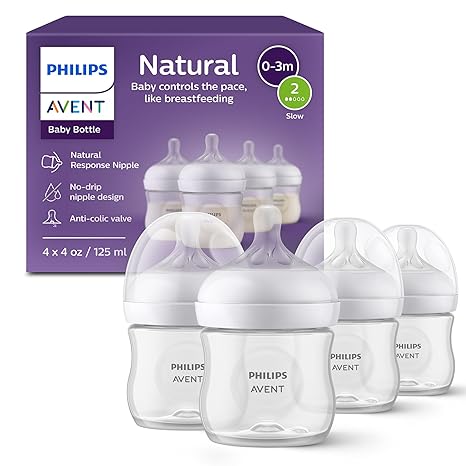
Best for: Parents who combine breastfeeding and bottle feeding.
Dr. Brown's Natural Flow Anti-Colic (2 oz, 4-Pack)
Pros
- Excellent for reducing gas and colic.
- Includes preemie slow-flow nipples.
- Trusted by many hospitals and pediatricians.
Cons
- More parts to clean.
-
Can leak if assembled incorrectly.

Best for: Babies with colic, reflux, or frequent gas.

Pigeon PPSU Wide Neck (8 oz, 2-Pack)
Pros
- Ultra-soft nipple closely mimics breastfeeding.
- Durable PPSU material withstands repeated sterilization.
- Wide neck makes cleaning easy.
Cons
- More expensive than standard plastic bottles.
-
Fewer bottles included per pack.

Best for: Parents looking for a premium bottle that closely resembles breastfeeding.
We personally used all three of these bottles while combination feeding our two babies. We started with Pigeon during the newborn stage, and it quickly became our favorite. We found the nipple flow to be just right for our newborns, and we really liked the shape and smaller size of the bottle. For combination feeding, Pigeon worked especially well for us because the nipple felt natural and made it easier to switch between breastfeeding and bottle feeding.
We also tried Dr. Brown’s, which is a popular choice and worked well, but for the newborn stage, we personally preferred Pigeon. The combination of the nipple shape, flow, bottle size, and overall feel made Pigeon the bottle we reached for most often during those early months.
After about six months, however, our preference changed. At that point, we found Philips Avent to be a better fit for our babies than both Pigeon and Dr. Brown’s. As our babies got older and their feeding needs changed, we appreciated the Avent bottles more and found them easier and more practical for this stage.
Our Personal Recommendation
Based on our experience with all three bottles, we wouldn't necessarily choose just one bottle for the entire first year.
For newborns and babies under 6 months, our pick is Pigeon. We especially liked it for combination feeding and found the slow flow, nipple shape, and smaller bottle size to be a great fit during the newborn stage.
After 6 months, our pick is Philips Avent. As our babies got older, Avent became our preferred option and was the bottle we liked using most.
Every baby is different, so what worked best for our two babies may not be exactly what works for yours. But after personally using all three, this is the combination we would choose based on our own experience: Pigeon for the newborn stage, then Philips Avent after 6 months.